01 / THE REFERENCE EDITION
The surface that changes without changing
Imagine a small, highly polished steel plate beneath a lamp, with darker surroundings beyond it. From one position, the plate returns a bright reflection. Move your head while leaving everything else alone, and the same face can become remarkably dark. No black coating has appeared. The illumination reaching your eye has changed.612
This is the observation behind the watchmaking expression black polishing. The finish is associated with a carefully prepared, mirror-like surface whose appearance can shift strongly with the viewing and lighting arrangement. Black describes an appearance under particular conditions, not a permanent colour of the metal.14
The interesting question is therefore not how polishing makes steel absorb all light. It is how surface preparation makes the direction of reflection so conspicuous. To answer it, we need to separate the light arriving at the surface, the directions in which it leaves, and the small portion that reaches an observer.
02 / THE REFERENCE EDITION
A mirror reflects an environment
For an ideal smooth surface, the angle of reflection equals the angle of incidence. Both are measured from the normal: an imaginary line perpendicular to the surface. The incoming and reflected rays lie in the same plane, on opposite sides of that normal.6
A real polished metal surface directs much of its reflected light around the corresponding mirror direction, rather than distributing it evenly. If a bright source lies in the direction reflected towards your eye, the surface can look bright. If that direction instead corresponds to a dark part of the surroundings, it can look black. The source may still illuminate the metal; its strongest reflected contribution simply misses you.912
This is not a claim that every photon leaves in one direction. Lamps occupy an area, surfaces have residual texture, and metals absorb some incident energy. Direction, reflected intensity and absorption are different questions.10
A broad luminous surround can keep a polished face bright over more viewing positions than a small source against darkness. There is consequently no universal angle at which every black-polished component must turn black. The environment is part of the appearance.12
03 / THE REFERENCE EDITION
Four names, overlapping practices
The terminology is less uniform than an elegant glossary might suggest. Patek Philippe connects mirror, black and specular polish, and gives poli miroir and poli noir as related French expressions. In that usage, different names describe the changing appearance of the polished surface.4
Henrik Korpela's article in the November 2015 issue of Horological Times likewise introduces flat polishing as a finish sometimes called mirror or black polishing. Its title is Hand Finishing of Movement Parts: Polishing Flat and Black with the Tripod, beginning on printed page 21.2
The Fondation Haute Horlogerie also links black and flat polishing. Lange, however, presents flat polishing and black polishing as separate entries with different working descriptions.51
These accounts should not be forced into one universal recipe or hierarchy. In optics, specular describes mirror-directed reflection; in a workshop, a polishing name can also imply a particular operation. A useful description therefore identifies the surface, its intended geometry and the method, rather than relying on the name alone.10
04 / THE REFERENCE EDITION
Flatness, texture and a scratch
Flatness concerns departure from a plane across a specified surface. Roughness concerns finer irregularities, described through measurements whose sampling and spatial scale matter. A scratch is a local feature; it may affect a texture measurement, but is not a synonym for roughness or flatness. A meaningful roughness figure needs a measurement method and evaluation conditions, not just an impressive number.78
The distinction is visible even without instruments. A curved mirror may look brilliantly smooth while plainly not being flat. Conversely, a nominally planar face may retain abrasive marks that scatter light. The larger-scale shape sets the local mirror directions; finer texture influences the spread of reflection around them. Shine alone cannot establish the shape of the underlying surface.79
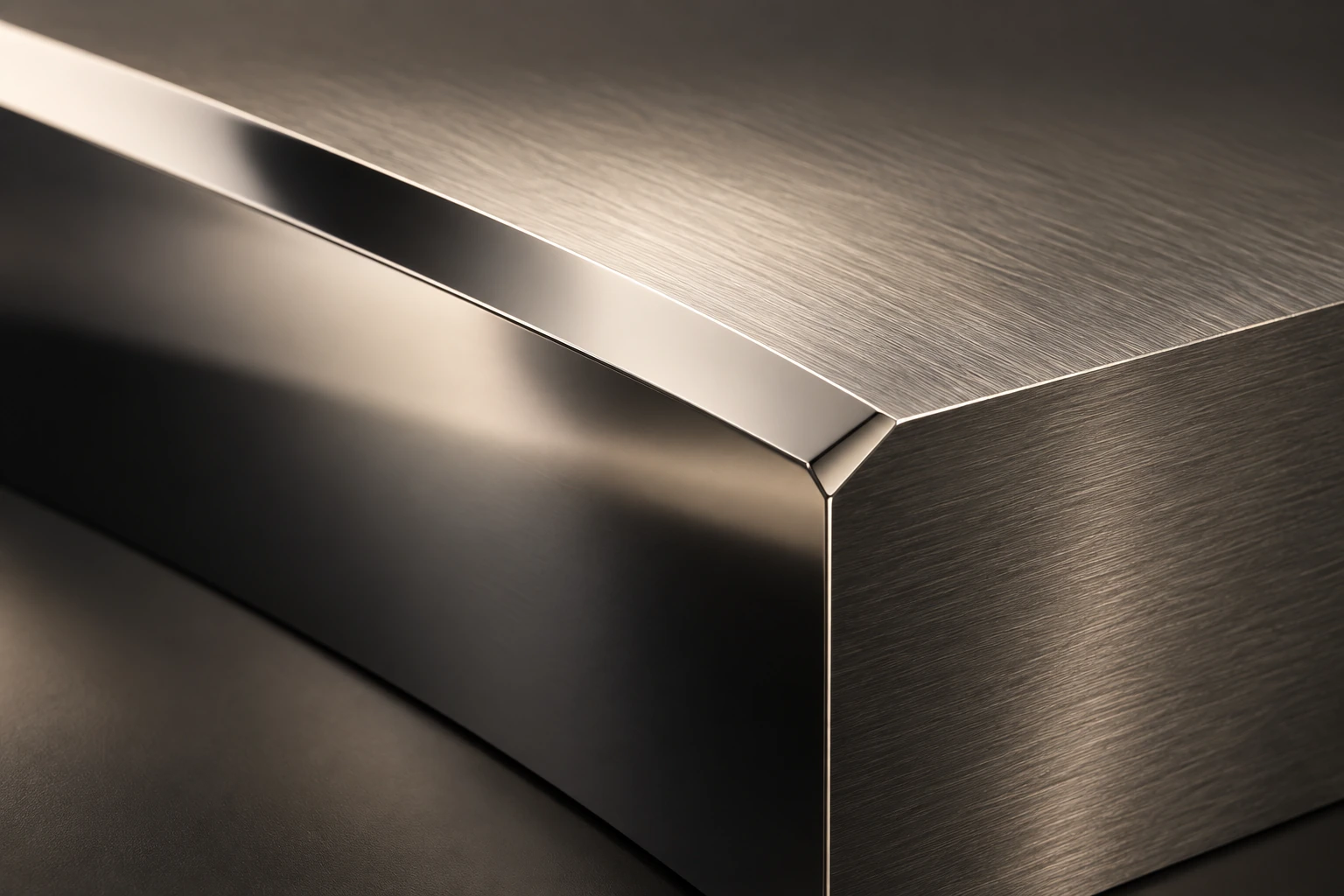
Brushing makes texture intentional. Its directional grooves can spread reflections differently along different directions, producing an elongated or directional highlight. A brushed metal surface is not necessarily an evenly diffuse reflector: it can retain a strong directional response.9
For black polishing, preserving the intended plane and refining its texture are related but separate tasks. Neither a dark photograph nor an uninterrupted-looking highlight establishes atomic flatness, zero roughness or the absence of every microscopic scratch. Those are stronger claims than the visual observation supports.78
05 / THE REFERENCE EDITION
What happens at the polishing plate
Published workshop descriptions offer useful specifics without supplying a single mandatory process. Armin Strom describes preparing steel with diamond paper, then working it on a tin plate with diamond paste. Lange's black-polishing account also specifies a tin plate, with specialised abrasive pastes. Patek Philippe's mirror-polishing entry instead describes a flat zinc plate and fine diamond powder in oil.1114
Tin should not silently replace zinc in the retelling. These are accounts of particular practices, not evidence that every finisher uses the same plate, carrier or abrasive sequence. Nor do they establish a universal grain size or required duration.
The broader operation is abrasive refinement: preparing the surface and reducing unwanted marks while retaining the intended form. The Fondation Haute Horlogerie describes the polisher's work in terms of deburring, smoothing and finishing with different abrasive materials and supports.5
The carrier, contact surface and abrasive belong to a working system. Knowing only that diamond compound was used does not tell a collector how the part was supported, how its geometry was preserved, or what inspection led the finisher to stop. Those are more informative questions than asking whether the work followed a supposedly secret recipe.
06 / THE REFERENCE EDITION
The difficult part is control
The hand matters through decisions, not through a guarantee attached to the word handmade. Armin Strom stresses pressure control in its black-polishing description. Lange warns, in its separate flat-polishing account, that contamination or excessive pressure can undo careful work. These observations concern managing contact and protecting an already refined surface.111
Lange gives a concrete example for flat polishing: holding the part in elderberry pith and guiding it in figures of eight over films with progressively finer diamond powder. This is that workshop's described method, not a rule for every black-polishing operation.1
There are two objectives to hold together: improving the finish of a face and preserving the geometry that makes it the intended face. Removing an unwanted mark is not permission to erase a deliberate boundary. The finished component still needs to retain the distinctions between its top, flanks and bevels.
For the collector, this changes what deserves attention. A convincing finish is not simply the darkest patch in a publicity image. It is a considered relationship between texture, shape and adjoining surfaces. For the maker, the question is whether the chosen process produces that result consistently on the component at hand.
Time can describe a particular job. Without its starting condition, material, geometry and acceptance criteria, it is a poor substitute for describing what was accomplished.
07 / THE REFERENCE EDITION
An edge is another surface
Anglage and chamfering concern edges. In watch-finishing accounts, this commonly includes forming a bevel between a face and its flank, then finishing or polishing it. It is not the same operation as polishing the broad planar face. Lange's description emphasises consistency of bevel width and angle; Armin Strom describes its own bevel work with files and subsequent polishing tools.111
The distinction matters optically. A bevel has a different normal from the face beside it. Under the same lamp and viewing direction, one may return a bright reflection while the other reflects a darker region. A bright outline around a dark face therefore needs no different black material at its centre.612
It also explains why a polished edge does not certify that the neighbouring face has received the same finish. They are separate areas with potentially different preparation and optical behaviour. Observe the width of the bevel, its continuity and its junction with the face. An attractive glint is a starting point for looking, not a complete account of how the edge was made.
08 / THE REFERENCE EDITION
Where Zaratsu belongs
Zaratsu shares an interest in clear reflections and controlled geometry, but its published process should not be collapsed into the tin-plate accounts above. Grand Seiko describes holding the work against the front, rather than the rim, of a rotating metal disc carrying abrasive paper. Its account then specifies a final buffing stage to bring out the mirror finish.3
The same source identifies pressure, contact time and movement across the disc as variables requiring control. It is an account of the manufacturer's case-finishing practice, not a definition of every mirror-polishing operation.3
The useful distinction is between a desired optical appearance and the route taken to achieve it. A mirror-like result does not identify its manufacturing history by itself. Equally, different procedures do not suspend the law of reflection.6
Descriptions such as distortion-free are best read here as manufacturing aims, not as supplied metrology showing literally zero deviation. Comparing the procedures illuminates their different tools and handling demands; it does not establish that one name guarantees a higher grade than the other.
09 / THE REFERENCE EDITION
How to look more carefully
Begin with one change. Keep the object and lamp still, then move your viewing position. Notice whether the bright region travels across the face, whether the face darkens together, and whether fine lines become visible as the reflection changes. This is an observation exercise, not a grading test.69
Next, consider what surrounds the lamp. A reflected dark card or dark room area can make a polished surface look very different from the same surface reflecting a broad light panel. With a brushed finish, also note the direction of the grain: its highlight may behave differently along and across that direction.129
Ask which area has been black polished: the entire upper face, a screw head, or only a selected surface? What term does the workshop use? Which preparation and final polishing stages does it describe? Under what lighting and magnification does it inspect the result?
No collector needs to touch an exposed movement or dismantle a watch to pursue those questions. A maker's explanation and suitably varied views are more useful than risky handling undertaken merely to obtain one dramatic black reflection.
10 / THE REFERENCE EDITION
What the image cannot finish for us
A photograph can show a surface's appearance in the arrangement recorded by the camera. It does not, by itself, separate the influence of lighting, surrounding objects and surface texture. A moving view provides more information, but still does not become a calibrated roughness or flatness measurement.7812
Likewise, a mirror-like image cannot establish the abrasive sequence, plate material, working time or operator's decisions. Those require information about the process. Seeing the outcome and knowing its manufacture are complementary forms of understanding, not interchangeable ones.
Black polishing is worth examining because its appearance makes a precise relationship unusually legible. The metal has not become a black pigment. Its prepared surface, the illumination and the observer have produced a dark view. Move within that relationship, and brightness can return.1012
The craft lies in preparing the surface with intention. The collector's task is to recognise that intention without asking a single reflection to prove everything.
Andrew E H MokEDITOR-IN-CHIEF
Research and visualisation note
This feature is based on public technical and process literature, not interviews, workshop visits or measurements by HonorPrice™. Korpela’s title, authorship, opening page and introductory terminology were verified in AWCI’s November 2015 preview; the subsequent technical pages are not included in that public file. The three visualisations use generic samples and explanatory geometry, not measured surface data or validated simulations of a maker’s components. Research checked 6 October 2026.
THE RESEARCH
Sources, in full.
- S01
A. Lange & Söhne. Finishing and Engraving n.d.
- S02
Henrik Korpela. Hand Finishing of Movement Parts: Polishing Flat and Black with the Tripod 2015-11 · Public preview, printed p.21
- S03
Grand Seiko. Why Zaratsu polishing? n.d.
- S04
Patek Philippe. Glossary — Mirror; Mirror polishing n.d.
- S05
Fondation Haute Horlogerie. Polisher n.d.
- S06
Samuel J. Ling, Jeff Sanny, William Moebs. University Physics Volume 3, §1.2: The Law of Reflection 2016-09-29
- S07
Edmund Optics. Understanding Optical Specifications n.d.
- S08
Victoria Marcune, Shawn Iles. Understanding Surface Roughness n.d.
- S09
Matt Pharr, Wenzel Jakob, Greg Humphreys. §9.6: Roughness Using Microfacet Theory 2023
- S10
Matt Pharr, Wenzel Jakob, Greg Humphreys. §9.3: Specular Reflection and Transmission 2023
- S11
Armin Strom. Swiss Watch Hand Finishing n.d.
- S12
Matt Pharr, Wenzel Jakob, Greg Humphreys. §13.1: The Light Transport Equation 2023