01 / THE REFERENCE EDITION
A wheel that keeps returning
On the dial, a seconds hand advances. Inside a conventional mechanical watch, the balance wheel turns one way, slows, then turns back. The hands accumulate movement; the balance repeats it. Understanding the connection means asking not just what makes the mechanism move, but what prevents it from running at any speed it happens to reach.17
This account follows a watch with a Swiss lever escapement, the mechanism linking the gear train to the balance. Its essential relationship works in both directions: the train supplies energy to sustain the balance, while the balance controls when the train can advance. Neither function alone explains timekeeping.15
02 / THE REFERENCE EDITION
Energy is not yet a timetable
The mainspring is the energy store: a coiled strip housed in a drum called the barrel. Turning the crown winds it through a winding mechanism. In an automatic watch, a moving rotor can also supply winding energy. Automatic winding changes how energy is replenished, not the need for a regulating system.12
Consider a conventional hand-wound going barrel. Winding turns the arbor, the central shaft, and tightens the spring around it. During ordinary running, with no winding input, the arbor is restrained against unwinding; the spring instead drives the barrel drum. Teeth around the drum pass that motion into the train.2
The spring supplies torque, a turning effect. The train and escapement determine how its stored energy is used over time. Winding is therefore not the same operation as regulating: one replenishes the store, while the other concerns the pace of the oscillator. Stored energy alone cannot define the interval that the hands are meant to indicate.124
03 / THE REFERENCE EDITION
What the wheels count
The going train is a sequence of meshing wheels and pinions, the smaller toothed members. A wheel driving a smaller pinion makes it turn faster; a wheel fixed to that pinion’s shaft shares its speed. Tooth counts establish relationships between rotations. They do not establish an absolute duration without a time reference.3
The oscillator provides that reference through the escapement. The train’s gearing relates its regulated progression to the indications on the dial. The hands are driven from the train, not by energy emerging from the balance as though it were the last motor in a series.13
For a conventional twelve-hour display, a further reduction called the motion work makes the hour hand turn once for every twelve revolutions of the minute hand. That relative rate is a gearing decision. Whether those revolutions keep agreement with external time depends on the regulating system.11
04 / THE REFERENCE EDITION
Two springs, different jobs
The hairspring, also called the balance spring, is not a smaller substitute for the mainspring. Attached to the balance assembly and to a fixed support, it flexes as the balance turns and provides a restoring torque. The balance’s inertia carries it through its central position; the spring then slows and returns it.46
Together they form an oscillator. The spring’s elastic behaviour and the balance’s moment of inertia — its resistance to changes in rotational motion — govern its natural rhythm. Friction and other losses would gradually reduce the motion without replenishment. The escapement supplies that replenishment in brief transfers rather than pushing the balance throughout its entire arc.45610
Amplitude describes the angular excursion from the central position to a turning point. Frequency describes how often a complete cycle occurs. A wider swing and a faster rhythm are therefore different observations. Nor should a real watch be treated as an ideal oscillator whose timing is entirely immune to changing operating conditions.78910
05 / THE REFERENCE EDITION
Release, impulse, lock
The Swiss lever escapement places a pivoted lever, the pallet fork, between the escape wheel and the balance. Two pallet stones interact with the wheel’s teeth. At the other end, the fork engages a roller jewel carried with the balance. These are working contacts: the jewel surfaces participate in controlling and transmitting motion.5612
Begin with one pallet holding the escape wheel. The balance is still free to move. As it returns towards its central position, the roller jewel enters the fork and moves it enough to release the locked tooth. At this stage, the balance is doing the unlocking; the escape wheel has not simply struck it into motion.57
Once released, the train-driven escape wheel pushes against the pallet’s inclined impulse surface. This drives the fork, which transfers energy through the roller jewel to the balance. That is an impulse: a transfer of energy that helps sustain the balance’s oscillation. The driver has changed during the encounter, from balance to train.156
After impulse contact ends, the balance can swing clear of the fork. The wheel advances through a short interval called drop before another tooth is caught by the opposite pallet. The fork settles against its banking limit, a stop restricting its travel, while the balance continues its arc and eventually reverses under the hairspring’s action.57
On the return journey, the other pallet is unlocked and the process repeats. The balance reverses direction, while the escape wheel makes a net advance in one direction. In this conventional arrangement, each complete back-and-forth cycle receives two impulses. Locking the wheel does not mean locking the balance.67
06 / THE REFERENCE EDITION
What 4 Hz actually counts
One oscillation means a complete journey from one turning point to the other and back. Each half is a beat, also called a vibration in watchmaking. Hertz, abbreviated Hz, counts complete cycles per second here. Confusing a beat with a full oscillation doubles or halves the stated frequency.89
Take an illustrative 4 Hz oscillator. It completes four full cycles, or eight beats, per second. Multiplying by 3,600 gives 28,800 vibrations per hour, written vph. These are two expressions of the same intended rhythm, not two separate performance scores. The calculation does not certify how accurately a particular watch maintains that rhythm.8910
07 / THE REFERENCE EDITION
What the maker adjusts
Regulation addresses that agreement with a reference. In designs with regulator pins, changing the hairspring’s effective working length changes the rate: shortening it generally raises the frequency. Other designs alter the balance’s moment of inertia with adjustable masses. Moving mass farther from the axis increases inertia and, with the spring otherwise unchanged, lowers the frequency.410
These adjustments concern an interacting mechanism, not just a number on a specification sheet. The geometry of the pallet contacts and the quality of assembly affect how consistently locking and impulse occur. Managing friction matters too. An intended frequency is only a starting point; the watchmaker must examine the behaviour of the assembled movement.1510
For the reader, a clearly identified, slowed demonstration is more revealing than a blur of moving parts. Follow one unlock, one impulse and the interval when the balance swings clear. Check the stated playback speed before counting. No dismantling is needed to understand the sequence.57
Our feature on Black Polishing examines how a prepared surface meets the light. Here the question is how prepared parts work together. A luminous finish can invite close attention, but it cannot report a watch’s timing error. The hands display an accumulated count; the mechanism must make those counted intervals dependable.110
Andrew E H MokEDITOR-IN-CHIEF
Research and visualisation note
This feature explains a conventional detached Swiss lever escapement with a balance and hairspring. Its barrel example is an ordinary hand-wound going barrel. The 4 Hz example is nominal arithmetic, not a specification or measurement of a named calibre. No workshop visit, interview, photographic session, timing measurement or external expert review was undertaken.
The manuscript’s research record documents institutional technical text and selected full-text academic passages. Figures 1–2 in S06 and Figures 5 and 7 in S07 were inspected; Figure 6 in S07 was not visually verified. Horopedia’s English pages carry AI-assisted translation notices; the original French pages were not separately verified. Research checked 8 October 2026.
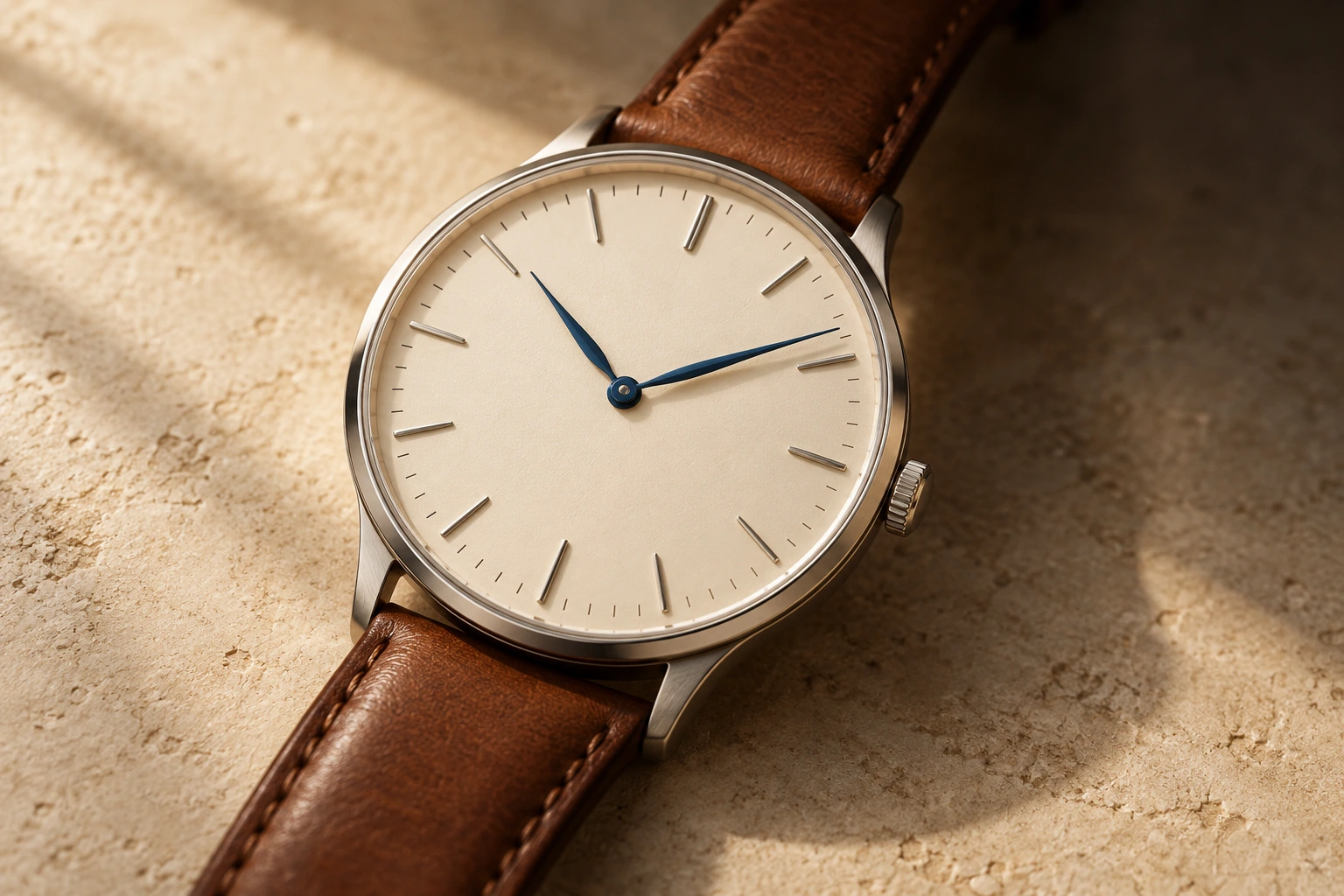
The cover is AI-generated editorial illustration, not a photograph of a named watch or calibre. The three original diagrams show functional connections, event order and ideal frequency arithmetic. They are not a movement layout, a dimensioned model, measured contact timings or a validated mechanical simulation. Event cards and equally spaced timeline points describe different things.
THE RESEARCH
Sources, in full.
- S01
Christophe Roulet. How does a mechanical watch work? 2023-04-25
- S02
Horopedia Foundation. The Motor Organ (Power Source) (the Barrel) n.d.
- S03
Horopedia Foundation. The Counting and Transmission Mechanism n.d.
- S04
Fondation Haute Horlogerie. Balance spring n.d.
- S05
Horopedia Foundation. Distribution Mechanism – Swiss Lever Escapement n.d.
- S06
Feng-Ming Ou, Hsu-Chien Wu. Motion and Torque Analyses of Swiss Lever Escapement Mechanism for Energy Harvesting Application 2025 · Relevant full text and Figures 1–2
- S07
Brian M. Naperkoski. Exploring the Dynamics of a Mechanical Watch Lever Escapement using Finite Element Analysis 2022-09-29 · Relevant full text; Figures 5 and 7; Figure 6 not visually verified
- S08
Fondation Haute Horlogerie. Oscillation n.d.
- S09
National Institute of Standards and Technology (NIST). Time and Frequency from A to Z, H 2010-05-12
- S10
Horopedia Foundation. Correcting the Daily Rate n.d.
- S11
Horopedia Foundation. The Motion Work n.d.
- S12
The Seiko Museum Ginza. The lever escapement that led to modern developments n.d.