01 / THE REFERENCE EDITION
A highlight that will not stay still
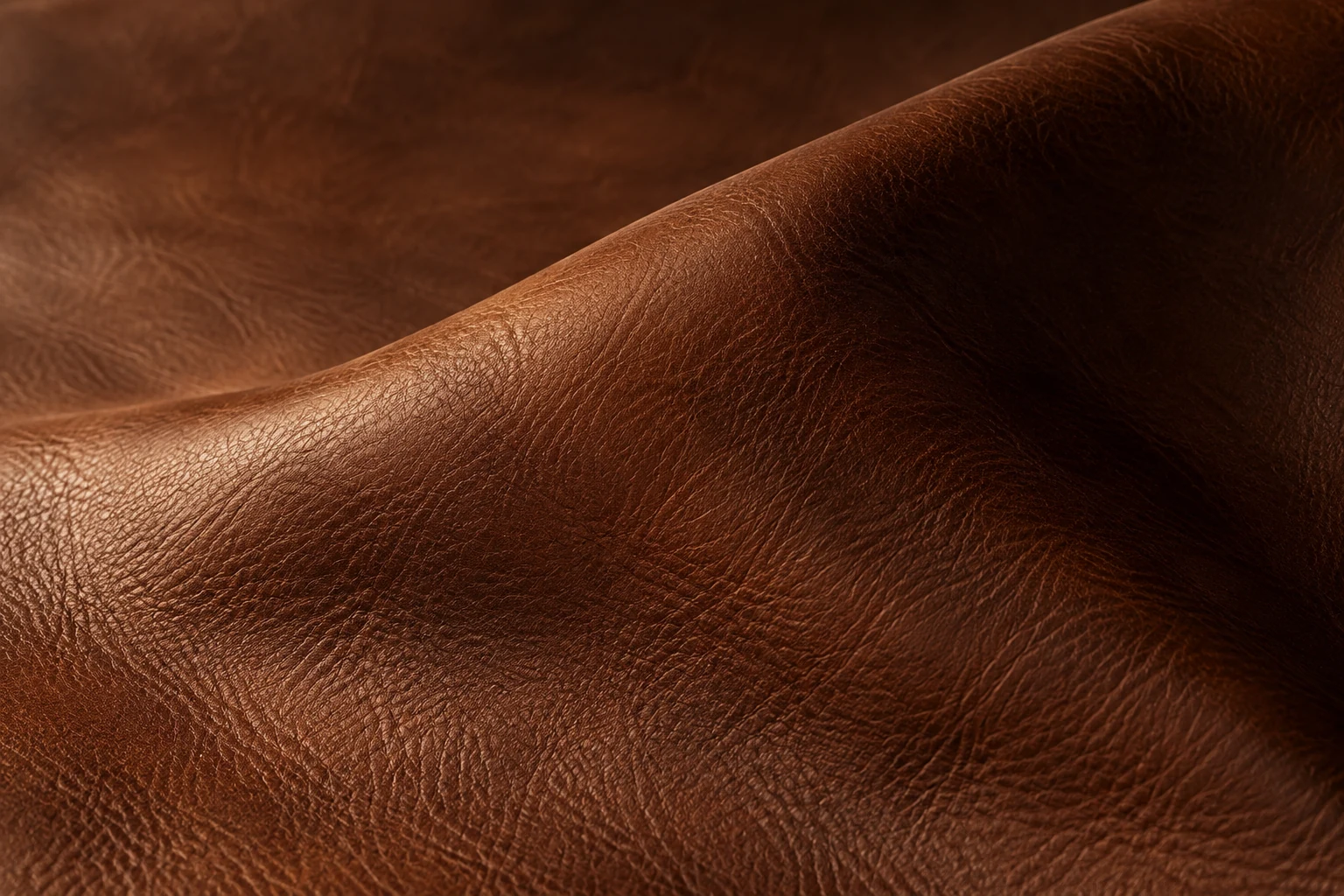
Imagine a length of silk lying in a shallow fold. Move a lamp to one side without touching the cloth. A bright band may travel across the fold while another area becomes quiet. Keep the lamp still and change your viewing position: the balance can shift again. The material has not changed. The relationship between its surfaces, the light and your eye has.47
That small observation leads beyond the familiar description of silk as shiny. Its lustre is not a single ingredient, delivered intact from cocoon to dress. It emerges across several scales: the fibre, the yarn assembled from fibres, and the fabric made from yarns. Each stage gives the maker another way to organise what the eye receives.4910
02 / THE REFERENCE EDITION
Three scales, three different decisions
A fibre is the fine, slender building element. A yarn is a continuous strand suitable for textile making. In a woven fabric, yarns interlace to form a surface. These are related structures, not interchangeable names.10
For reeled silk, strands drawn from several cocoons are brought together to make a usable yarn. The filament seen under a microscope is therefore not the same thing as the thread crossing a piece of cloth. Combining and twisting yarns adds further structure before weaving begins.1011
The distinction also clears up a common confusion. Silk identifies a material; satin identifies a weave. Silk can be woven into satin, but also into plain weave and other structures. A satin need not be silk. Saying “silk satin” supplies two pieces of information: what the yarns contain and how they interlace.159
03 / THE REFERENCE EDITION
The fibre is not a perfect prism
The cultivated mulberry silkworm, Bombyx mori, produces fibroin filaments commonly described as roughly triangular in cross-section. “Roughly” matters. These are biological forms, not identical optical prisms. Other silkworm species can produce different cross-sectional shapes, so one diagram cannot stand for every silk.58
The outline helps determine which directions the local surface faces. Along with surface smoothness and fibre orientation, this affects how light is returned. A directional, mirror-like component is called specular reflection. Other light is scattered through interactions within the material and among fibres, contributing to a less sharply directed appearance.467
The useful picture is therefore a collection of differently oriented surfaces, not a bundle of perfect triangles making rainbows. Cross-section contributes to the geometry; it does not, by itself, explain the whole cloth. What matters next is how those fibres are arranged together.478
04 / THE REFERENCE EDITION
What twist asks the light to do
Twist turns the components of a yarn around its length. Rather than remaining nearly parallel to the yarn axis, surface fibres follow more oblique paths. Changing those paths changes the directions presented to the light. Fibre orientation is consequently an appearance variable, not merely a construction detail.710
A maker can choose different yarn constructions for the two directions of a cloth. In the silk crêpe examined by Hiroaki Nakazato and Masanori Meguro in 1969, the weft was highly twisted; the other fabrics in their study had different specifications. That is a useful reminder that a fabric name can conceal several decisions at once.2
It is less useful to turn twist into a universal brightness dial. A change in fibre alignment operates alongside yarn thickness, surface texture and the weave that holds the yarn in place. A photograph of two unrelated silks cannot separate those effects.127
05 / THE REFERENCE EDITION
The surface between the crossings
Warp yarns run lengthways; weft yarns cross them. In plain weave, a weft passes over one warp, then under the next, with the following row reversing that sequence. These frequent interlacings repeatedly interrupt the exposed run of each yarn.910
A float is a stretch passing across several opposing yarns before interlacing again. The eight-end, weft-faced satin considered here lets each weft float over seven warp yarns before passing under one; the binding points are staggered. Longer exposed runs can make the surface read more continuously in the float direction.14
Chooja Jung and Nobuko Naruse compared eight silk weaves in 1995 using matching yarn size and weaving density. They nevertheless recorded differences in fabric thickness: changing the weave also changes geometry. Weave-related differences in perceived lustre were clearer in their white samples than in their black ones, and viewing direction mattered. The experiment supports an interplay of structure, colour and direction, not a rule that satin always wins.1
06 / THE REFERENCE EDITION
Removing the gum, adding colour
The cocoon adds another layer to the story. Fibroin forms the structural filaments, while sericin is the gum-like protein coating that binds them. Degumming removes sericin, exposing the filaments and helping produce a softer, smoother, more lustrous textile. The treatment is part of making the surface, not merely washing an already finished fabric.56
Processing also has consequences beyond appearance. In one comparison of degumming methods, Ting-Ting Cao and colleagues found similarly smooth filament surfaces but different tensile properties — how the filaments behaved when pulled. A smooth-looking surface did not disclose everything about the fibre beneath it. The choice of treatment therefore cannot be judged by shine alone.6
Dyeing adds another variable. Within the fabric types examined by Nakazato and Meguro, perceived lustre correlated with measured specular reflection and lightness. Their conclusions were qualified by fabric type; yarn size, twist and density differed between constructions. Colour and gloss meet in perception, but neither a colour name nor a weave name predicts the complete result.2
07 / THE REFERENCE EDITION
Look once, then change one thing
To look more carefully, keep a piece of cloth and its folds still. Fix your viewing position, then move one lamp without changing its brightness or colour. Watch where highlights appear, broaden or disappear. Next, leave the lamp fixed and move your head. These are two separate observations, not one combined flourish.47
Look along the two yarn directions and compare the visible stretches between crossings. When comparing separate swatches, ask whether yarn thickness, spacing, colour and finish also differ. A travelling highlight is evidence of directional appearance; it is not a certificate of authenticity, a grade or a verdict on overall quality.1679
The more revealing question is what the maker has chosen to make visible: a continuous sheen, a finely broken surface, or a quieter interplay between the two. Silk provides the material. Yarn construction and weaving give that material a particular way of meeting the light.149
Andrew E H MokEDITOR-IN-CHIEF
Research and visualisation note
This article draws on original journal papers, institutional materials and an author-page abstract. No reporting visit, interview, photographic session, material test or external expert review was undertaken. The independently drawn diagrams show structural relationships and a light-path schematic; they are not measurements, brightness predictions or validated simulations. The cloth-reflection source S04 was consulted at abstract level and thesis S08 only in the cited passage. The inaccessible CAMEO page was excluded as evidence. Research checked 6 October 2026.
THE RESEARCH
Sources, in full.
- S01
Chooja Jung, Nobuko Naruse. Effects of Weave on the Luster of White and Black Silk Fabrics 1995-05-10
- S02
Hiroaki Nakazato, Masanori Meguro. On Relation Between Sensory Test and Reflective Property of Fabric Luster 1969-05-10
- S04
Piti Irawan, Steve Marschner. Specular Reflection from Woven Cloth 2012-01 · Abstract consulted
- S05
Theresa Schmidt, Nils Puchalla, Marcel Schendzielorz, Annemarie E. Kramell. Degumming and characterization of Bombyx mori and non-mulberry silks from Saturniidae silkworms 2023-11-09
- S06
Ting-Ting Cao, Yuan-Jing Wang, Yu-Qing Zhang. Effect of Strongly Alkaline Electrolyzed Water on Silk Degumming and the Physical Properties of the Fibroin Fiber 2013-06-18
- S07
Yingjie Tang, Zixuan Li, Miloš Hašan, Jian Yang, Beibei Wang. Woven Fabric Capture with a Reflection-Transmission Photo Pair 2024-07-08
- S08
Naomi Luxford. Reducing the Risk of Open Display: Optimising the Preventive Conservation of Historic Silks 2009-12 · Cited thesis passage, p.20
- S09
The George Washington University Museum and The Textile Museum. Structure n.d.
- S10
The George Washington University Museum and The Textile Museum. Textile Terms n.d.
- S11
The George Washington University Museum and The Textile Museum. Fiber n.d.