01 / THE REFERENCE EDITION
The surface is only the beginning
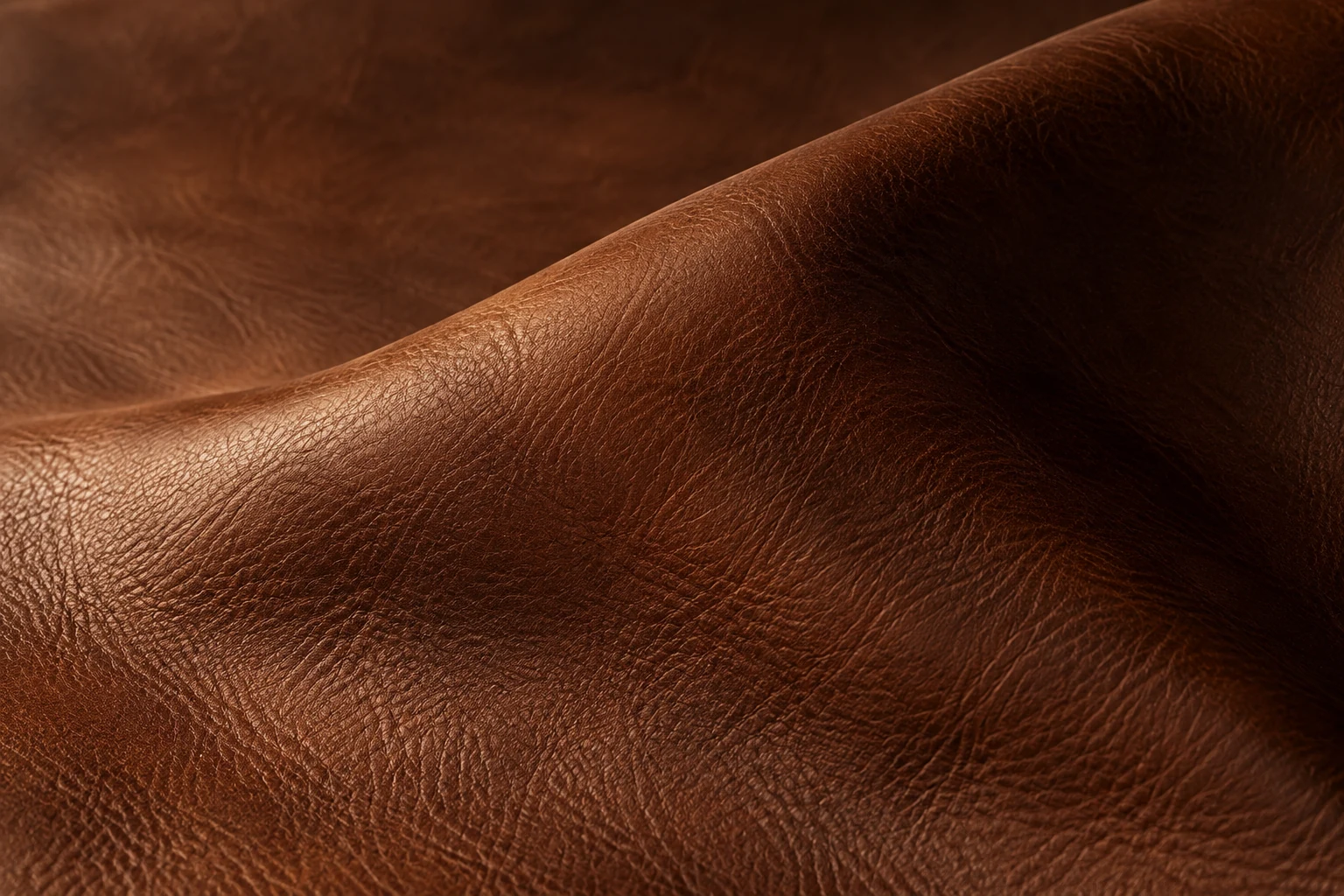
Imagine a piece of brown leather beneath a low lamp. Small ridges may catch the light while recesses remain darker. Move the lamp and another part of the pattern becomes prominent. What looks like a single surface already combines several variables: its shape, its colour and the way its outermost material reflects light.1011
Yet the image cannot tell you how easily the leather will bend. Smoothness beneath a fingertip and pliability in the hand describe different responses. To understand both, it helps to follow cattle hide through three connected decisions: what to preserve, how to condition its fibrous structure, and what to put on its surface.139
02 / THE REFERENCE EDITION
What remains of the hide
Leather begins with an existing network, not threads waiting to be woven. Its principal structural protein is collagen, organised into fibres and bundles. In making ordinary hairless leather, the hair and epidermis, the outermost skin layer, are removed. The grain is the surface revealed beneath them, with features associated with the former hair follicles.12
Full-grain describes preservation of that grain surface: none has been removed by corrective mechanical treatment. It does not mean that the leather retains the hide’s entire original thickness. A hide can be split horizontally, leaving a grain-bearing layer and a lower flesh split. Thickness can also be adjusted from the flesh side.234
Nor does full-grain tell us whether a coating has been added. It answers a question about the underlying surface, not every subsequent treatment. Keeping these descriptions separate allows a useful distinction: the grain may be preserved even when the final colour and touch have been deliberately modified.245
03 / THE REFERENCE EDITION
Making the structure supple
Tanning stabilises the collagen structure through its interaction with tanning agents. Vegetable tannage uses plant-derived tannins; chrome tannage uses chromium(III) salts. These are ways of transforming the hide, not names for the final varnish. The chosen tannage matters, but the finished feel also depends on what happens afterwards.13
Retanning introduces further tanning materials to adjust properties such as fullness and handle, the overall feel when leather is handled. Fatliquoring has a different task: oil-based formulations lubricate the fibres and help soften the leather. It is a manufacturing treatment within the material, not simply a polish applied to the finished face.23
Mechanical work adds another set of choices. Staking softens and stretches leather; dry milling tumbles it in a drum and can bring out its natural grain. Drying also influences the result. The character of a supple leather therefore belongs to a sequence of treatments, not to one reassuring word on a label.38
04 / THE REFERENCE EDITION
Colour and coverage are different choices
Dyeing gives leather colour. A pigmented surface finish adds colour through particles held in a binder, a film-forming material that attaches them to the surface. These approaches can be used together. The useful distinction is between colouring the leather and controlling how much of its underlying appearance remains visible through a finish.235
Aniline leather keeps the natural grain clearly visible. Under the ISO vocabulary used here, it may have no surface coating or a non-pigmented one. Transparent does not mean absent: a clear finish can leave the original surface legible while still being a material between that surface and your hand.25
Semi-aniline introduces a small amount of pigment while retaining a clearly visible natural grain. In pigmented leather, an opaque finish conceals the underlying appearance. That does not require a featureless sheet: the finished surface can still have relief. Coverage describes what is hidden; relief describes the shape that remains or is created.235
Full-grain and aniline consequently belong on different axes, not successive rungs of a quality ladder. One describes the preservation of the grain, the other the finish and its visibility. A meaningful specification needs both kinds of information rather than asking a single adjective to stand for the whole material.245
05 / THE REFERENCE EDITION
Leaving, refining and remaking the grain
A tanner can retain the original face, or modify it. In corrected-grain leather, buffing removes part of the grain before finishing refines the surface. A new pattern may then be embossed. This is deliberate reconstruction, distinct from revealing more of the existing grain through tumbling.2368
Buffing can also pursue a different result altogether. Nubuck is worked on the grain side to raise a fine, velvety nap: the term for short fibres standing at the surface. Suede has a napped surface too, commonly made on a flesh split. Their similar appearance does not mean that the same side of the hide was used.27
An impressed pattern is therefore not a record of the animal’s skin, just as a velvety face is not necessarily untouched. The informative question is which operation made the texture. Natural markings, raised fibres and an embossed design are different starting points for reading a finished surface.1678
06 / THE REFERENCE EDITION
The finish that meets the light
The relief visible to the eye is only one scale of texture. Finer surface irregularities also affect the directions in which light is reflected. In a useful optical model, these small areas face slightly different ways; a wider spread of their orientations spreads the directional reflection. A pronounced grain and a sharp local highlight can therefore coexist.1011
Specular reflection is the mirror-directed part of that response, not a synonym for luxury. The coating, its fine texture and the larger surface shape all matter. A matt-looking finish need not be unfinished leather, and an evenly coloured face need not be geometrically flat. Those appearances describe different properties.31011
Finishing operations let the maker alter gloss and handle while pursuing performance such as resistance to rubbing and repeated flexing. Those are design requirements, not results established by a photograph. The surface chosen to keep colour consistent need not be the one chosen to display every original marking. For a panel intended to hold its outline, a maker may favour firmness; a folding section may call for easier movement. Neither brief is answered simply by maximising softness or shine.23
There is no compulsory recipe of one operation followed by one coating. Mechanical work can occur before, after or between coating stages. The maker is choosing a working combination: how much texture to retain, how much colour variation to reveal, and how the finish should behave as the leather moves.38
07 / THE REFERENCE EDITION
Look, handle, then ask
Begin with one sample, held still, and one lamp. Change only the lamp’s position, keeping its colour and output constant; then repeat with the lamp fixed and your viewpoint moving. Notice whether you are following a highlight, a shadow or a mark in the colour. These need not move together.1011
On an unbacked handling sample, distinguish the feel of the face from the ease of bending the piece. When comparing swatches, ask whether their thickness, tanning, lubrication and finish differ. Matching their colour and lighting alone does not make them a controlled comparison, and looking closely is not an authentication test.139
The useful questions are concrete. Was the grain retained or buffed? Is its pattern original, enhanced by milling or embossed? How is the surface coloured and finished, and what use was that finish developed for? These answers connect what the hand and eye encounter to decisions a maker can actually explain.2368
Andrew E H MokEDITOR-IN-CHIEF
Research and visualisation note
This article concerns cattle leather and uses ISO 15115:2019 as its stated vocabulary reference. It draws on original institutional, laboratory and technical publications, with one explicitly limited thesis abstract. No workshop visit, interview, photographic session, material test or external expert review was undertaken. Definitions are not used as a certification or a hierarchy of luxury grades.
The source record for S03 is limited to readable process text; its figures and measured numerical results are not used. S09 was consulted only as an abstract and repository record. Research checked 7 October 2026.
The cover is AI-generated editorial imagery, not a documented sample. The three original explanatory diagrams distinguish structure, finish visibility and reflection paths. They are not microscopy, measured comparisons, brightness predictions or validated simulations of leather. Their captions state the scope of each illustration.
THE RESEARCH
Sources, in full.
- S01
Carole Dignard, Janet Mason. Caring for leather, skin and fur n.d.
- S02
ISO. ISO 15115:2019(en), Leather — Vocabulary 2019 · Vocabulary reference, 2019 edition
- S03
Michael Black, Michele Canova, Stefan Rydin, Bianca Maria Scalet, Serge Roudier, Luis Delgado Sancho. Best Available Techniques (BAT) Reference Document for the Tanning of Hides and Skins 2013-11-07 · Relevant process text; figures not verified
- S04
Leather Research Laboratory. Full Grain & Top Grain n.d.
- S05
Leather Research Laboratory. Aniline, Semi-Aniline & Pigmented Leather n.d.
- S06
Leather Research Laboratory. Corrected Grain Leather n.d.
- S07
Leather Research Laboratory. Suede & Nubuck Leather n.d.
- S08
Leather Naturally. How is leather made? n.d.
- S09
Yu Wenge. The mechanical properties of leather in relation to softness 1999 · Abstract and repository metadata only
- S10
Matt Pharr, Wenzel Jakob, Greg Humphreys. Physically Based Rendering, 4th edition, §9.6: Roughness Using Microfacet Theory 2023
- S11
Samuel J. Ling, Jeff Sanny, William Moebs. University Physics Volume 3, §1.2: The Law of Reflection 2016-09-29