01 / THE REFERENCE EDITION
An exceptional stone. A bounded conclusion.
In July 2025, GIA examined the Motswedi diamond in Botswana. On arrival, the principal stone weighed 2,488.32 carats. It appeared light brown. Infrared measurements supported a Type IIa classification—but the report also acknowledged that the stone’s size and irregular shape complicated the spectra, and that not every part could be analysed.8
That qualification deserves as much attention as the weight.
It does not diminish the stone. Nor does it cancel the laboratory’s conclusion. It tells the reader how far the observations reach. An important diamond demands this precision: not merely a distinguished description, but an account of how that description was established.
Type IIa is an especially revealing place to begin. It sounds like a grade above other grades. It is not one.
The distinction matters because a scientific name can retain its spelling long after its meaning has been enlarged beyond recognition. Before asking whether a designation makes a diamond exceptional, we must ask what the designation was designed to describe.
02 / THE REFERENCE EDITION
A classification, not a superlative
Diamond type concerns particular impurities and their configurations within crystalline carbon. Conventional infrared typing distinguishes nitrogen-bearing Type I material from Type II material without detectable type-defining nitrogen features. Type IIa must also be distinguished from Type IIb, whose defining characteristics are associated with boron.1
In practical terms, Type IIa does not exhibit the nitrogen features used for conventional infrared Type I classification or the boron characteristics defining Type IIb.
It is not a promise that every atom is carbon. “Not detected” describes a measurement with a limit; “absent” makes a stronger claim about the material. Those statements are not interchangeable.
Nor is a classification a complete inventory. A useful label deliberately compresses information. The responsible reader must know what was compressed, what was measured, and what the label leaves unresolved.
03 / THE REFERENCE EDITION
Two instruments, different questions
Fourier-transform infrared spectroscopy, or FTIR, records absorption across the infrared spectrum. Diamond itself has intrinsic infrared absorption, so a Type IIa spectrum is not a featureless line showing “nothing”. The relevant distinction lies in particular impurity-related features, not the absence of every signal.1
Photoluminescence spectroscopy, or PL, examines light emitted after excitation, commonly by a laser. It can reveal certain optically active defects at concentrations too low for conventional infrared typing.2
Yet PL is not simply FTIR with the magnification increased.
In a 2016 explanation, GIA researchers described infrared nitrogen detection limits around 1–5 parts per million, while certain nitrogen-vacancy centres could be detected by PL at 10 parts per billion or less. Those numbers concern different analytical targets and conditions. They are not two readings of total nitrogen, and they do not establish a universal sensitivity ratio for today’s instruments.2
The important relationship is complementarity. A method may be exceptionally sensitive to a particular defect without becoming a complete chemical census.
An authoritative-looking graph cannot decide which question we meant to ask. That responsibility remains ours.
04 / THE REFERENCE EDITION
Purity, clarity and colour are not synonyms
Clarity concerns inclusions and surface characteristics assessed under defined grading conditions. It is not a measurement of trace-element concentration. A diamond’s type therefore cannot be substituted for its clarity grade.9
Colour is a separate question again. Type IIa diamonds can be brown or pink rather than colourless. Plastic deformation and associated defects can contribute to such appearances, but not every brown or pink diamond shares one mechanism. The detailed defect responsible for deformation-related pink colour was still not fully understood in the 2023 research review cited here.111
This is where the word pure becomes least helpful when left alone. Does it mean a particular spectroscopic result, an absence of visible inclusions, a colour grade, or simply an impression produced by the lighting?
The questions are distinct even when the sales language combines them.
Motswedi’s reported appearance and classification offer a concrete reminder. There is no contradiction to resolve between a Type IIa result and visible body colour. The contradiction exists only in the mistaken expectation that the type must function as a colour grade.
05 / THE REFERENCE EDITION
Natural is one question. Untreated is another.
Type IIa does not establish natural origin. GIA’s 2024 review describes colourless-to-near-colourless laboratory-grown diamonds as Type II and explains why identification uses multiple diagnostic observations. A referral from a screening instrument is a request for further examination, not itself a verdict of laboratory growth.4
A second distinction is equally important: a naturally formed diamond need not have an untreated colour. High-pressure, high-temperature treatment can alter the colour of some natural brown Type IIa diamonds.2
These questions should remain visible side by side:
How did the crystal grow? Has its colour subsequently been modified?
A satisfactory answer to the first does not supply an answer to the second. “Natural Type IIa” should never be allowed to stand in for a treatment assessment.
Nor should the distinction be turned into a judgement about the purchaser. Natural and laboratory-grown material can be discussed without disparaging either owner. The editorial obligation is to describe the object accurately, make the relevant disclosures intelligible, and avoid selling one attribute under another attribute’s name.
Disclosure is not an interruption of appreciation. It is what makes informed appreciation possible.
06 / THE REFERENCE EDITION
Rarity has a denominator
A study published by GIA in 2020 analysed faceted natural-colour D-to-Z diamonds submitted to its laboratories during a substantial portion of 2017. Type IIa accounted for 0.83% of that study population. The authors explicitly cautioned that laboratory submissions do not necessarily represent the entire market.3
The percentage is informative precisely because its boundary is stated. It is not a census of every diamond mined, every diamond sold, or the market in 2026.
There is also a subtler error to avoid. The frequency of Type IIa within a selected natural-diamond population does not tell us the probability that an unknown Type IIa stone is natural. Reversing the direction of that question requires different information.
A rare characteristic in one population can be common in another. Without knowing which population supplied the object, the rarity statistic cannot identify it.
For collectors, the practical consequence is simple: ask for the population before accepting the percentage, and ask what conclusion the percentage actually supports. A number need not be false to be used misleadingly. Sometimes the error is not in the arithmetic, but in the question the arithmetic has been made to answer.
07 / THE REFERENCE EDITION
The depth is in the evidence, not the label
Some diamonds open a much larger inquiry than their appearance suggests.
The term CLIPPIR brings together a family resemblance: Cullinan-like, Large, Inclusion-Poor, Pure, Irregular and Resorbed. It is not another spelling of Type IIa. The spectroscopic classification and the geological grouping overlap, but neither can simply replace the other.5
In studied CLIPPIR examples, mineral inclusions—including majoritic garnet and assemblages interpreted to record former calcium-silicate perovskite—support formation depths of approximately 360–750 kilometres. The same research contrasts these with the roughly 150–200-kilometre lithospheric setting commonly associated with many gem diamonds.5
The depth interval follows from mineral evidence and its geological interpretation. It is not a depth printed into the letters “IIa”, nor an exact coordinate assigned to every specimen.
Related research identified inclusions interpreted as remnants of an iron–nickel–carbon–sulphur metallic liquid, providing evidence for strongly reducing conditions in parts of the deep mantle.6
The most interesting feature may therefore be something a buyer first notices as an inclusion. Its significance depends on the question being asked. A characteristic relevant to clarity can also preserve information of scientific importance; that does not automatically make it more desirable in the market.
Appreciating the research does not require turning geology into a price argument. It requires allowing the object to have more than one kind of significance.
08 / THE REFERENCE EDITION
One famous name is not a map of every region
A large rough diamond is not necessarily spectroscopically uniform.
A 2018 GIA symposium abstract reported that analyses of faceted stones cut from Lesedi La Rona indicated an original rough containing both Type IIa and Type IaB regions. Constellation was classified as Type IaB. These observations must be attributed to that report and its analysed material, rather than expanded into an unsupported claim about every region of every associated stone.7
This is a more compelling account than a procession of famous names all assigned the same flattering label. It introduces a question that should accompany any important measurement:
Where was the observation made, and what does that location allow us to conclude?
A specimen, a fragment, a growth region and an entire rough are not interchangeable units of evidence. Moving from one to another requires justification.
09 / THE REFERENCE EDITION
Then consider the light
Spectroscopic identity does not finish the encounter with a polished diamond.
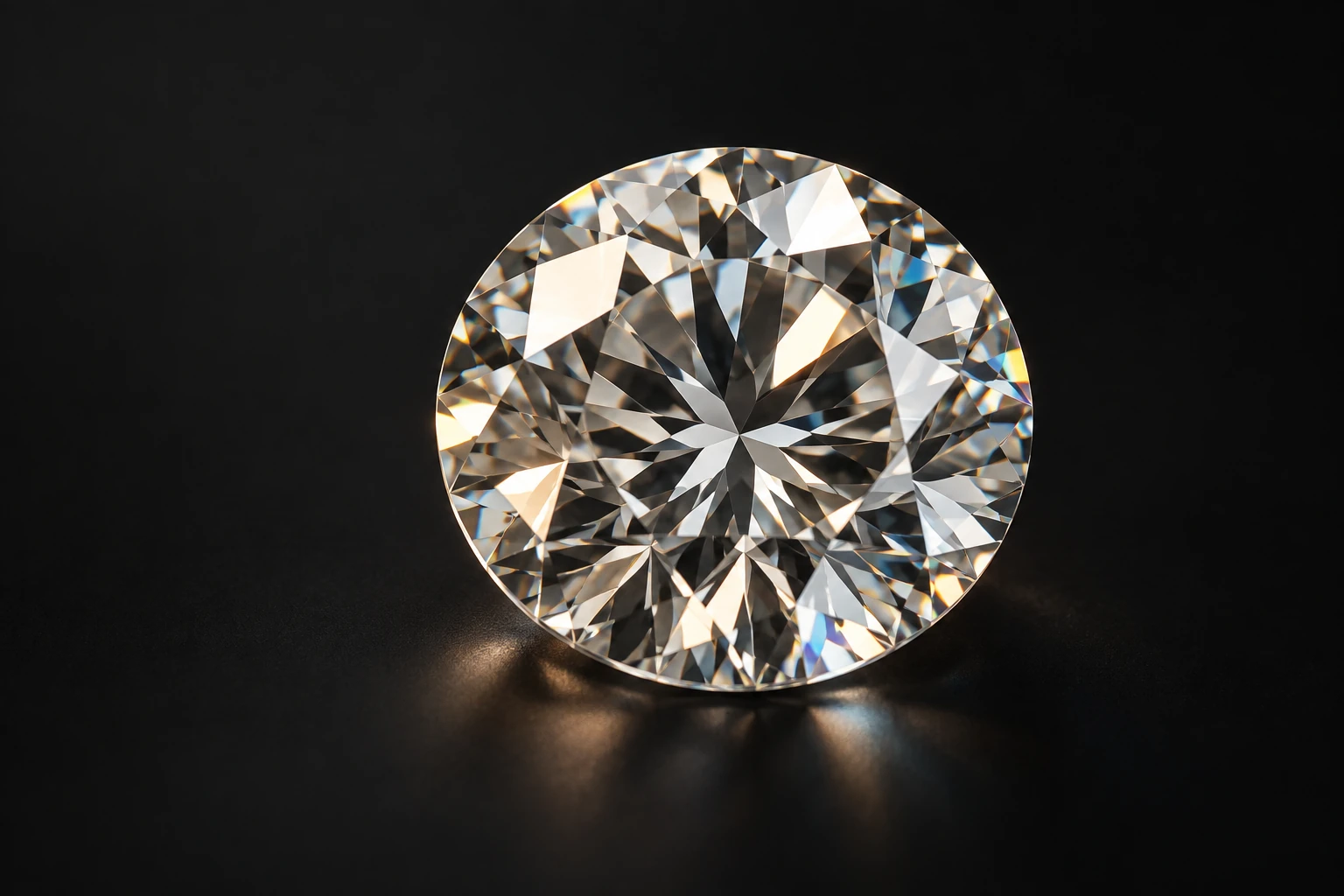
GIA distinguishes brightness, fire and scintillation in describing appearance: reflected white light, spectral colour associated with dispersion, and the changing flashes and patterns seen with movement. Cut, proportions and finish matter, while lighting, surroundings and the observer also influence what is seen.910
There is no warrant for turning a Type IIa label into an automatic enhancement of those qualities.
A meaningful comparison must control what it claims to compare. Change the illumination and the facet geometry together, then add more exposure and stronger colour saturation, and the resulting image cannot tell the viewer which difference caused the effect.
The illustrations in this edition use static diagrams and text to explain these distinctions. They do not model a measured stone, provide a grading result, or predict how an unseen diamond will appear.
The restraint is deliberate. A compelling image should reward attention to the material, not conceal the choices used to make the image compelling.
10 / THE REFERENCE EDITION
An object, not an adjective
The collector’s inquiry can now be organised without compressing everything into a single rank.
Ask what has been established about growth origin and treatment. Read the grading information on its own terms. Examine what the type adds, what any laboratory result actually covers, and whether a geological interpretation rests on evidence from this specimen or from a wider research population.
Keep documentary history separate from analytical identification. A story about ownership is not established by an infrared spectrum; a chemical classification is not established by an impressive ownership story.
Nothing in this approach asks the reader to stop finding diamonds beautiful. It asks for a more demanding form of attention: one that can appreciate an extraordinary object without requiring every fact about it to become a superlative.
Type IIa can be significant. It can contribute to a remarkable account of matter, growth and geological history. What it cannot do is carry every claim about quality, origin, treatment, appearance and worth on its own.
The question is therefore not merely, “Is this diamond Type IIa?”
It is “What has been established about this particular diamond—and what does the evidence leave open?”
That is not a smaller ambition for connoisseurship. It is a more exacting one.
Andrew E H MokEDITOR-IN-CHIEF
Research and visualisation note
This feature is a source-based editorial analysis, not a report of independent specimen testing by HonorPrice™. Measurements belong to the cited researchers. The diagrams are explanatory reconstructions unless explicitly identified otherwise. The Science paper cited below was checked through its institutional abstract; its detailed follow-up in Gems & Gemology was also consulted. References do not imply endorsement by their authors or institutions.
THE RESEARCH
Sources, in full.
- S01
Christopher M. Breeding; James E. Shigley. The “Type” Classification System of Diamonds and Its Importance in Gemology Gems & Gemology, 45(2), 96–111 · 2009
- S02
Sally Eaton-Magaña; Christopher M. Breeding. An Introduction to Photoluminescence Spectroscopy for Diamond and Its Applications in Gemology Gems & Gemology, 52(1) · 2016
- S03
Sally Eaton-Magaña; Troy Ardon; Christopher M. Breeding; James E. Shigley. Natural-Color D-to-Z Diamonds: A Crystal-Clear Perspective Gems & Gemology, 56(3) · 2020
- S04
Sally Eaton-Magaña; Matthew F. Hardman; Shoko Odake. Laboratory-Grown Diamonds: An Update on Identification and Products Evaluated at GIA Gems & Gemology, 60(2) · 2024
- S05
Evan M. Smith; Steven B. Shirey; Wuyi Wang. The Very Deep Origin of the World’s Biggest Diamonds Gems & Gemology, 53(4), 388–403 · 2017
- S06
Evan M. Smith; Steven B. Shirey; Fabrizio Nestola; Emma S. Bullock; Jianhua Wang; Stephen H. Richardson; Wuyi Wang. Large gem diamonds from metallic liquid in Earth's deep mantle Science, 354(6318), 1403–1405; DOI 10.1126/science.aal1303 · 2016
- S07
Ulrika F. S. D’Haenens-Johansson. The Lesedi La Rona and the Constellation—The Puzzle of the Large Rough Diamonds from Karowe Gems & Gemology, Fall 2018 Symposium, Diamond Geology · 2018
- S08
Tom Moses; Wuyi Wang. GIA Tests the World’s Second Largest Diamond GIA Research · 2025-08-15
- S09
GIA. Diamond Quality Factors GIA · n.d.
- S10
Kristin A. Aldridge. How Does Light Affect How My Diamond Looks? GIA Research · 2015-03-24
- S11
Evan M. Smith. Plastic Deformation: How and Why Are Most Diamonds Slightly Distorted? Gems & Gemology, Spring 2023, Diamond Reflections · 2023